Search This Blog

Showing posts with label at-risk youth. Show all posts

Sunday, September 30, 2007

The Children At Risk Foundation (CARF)


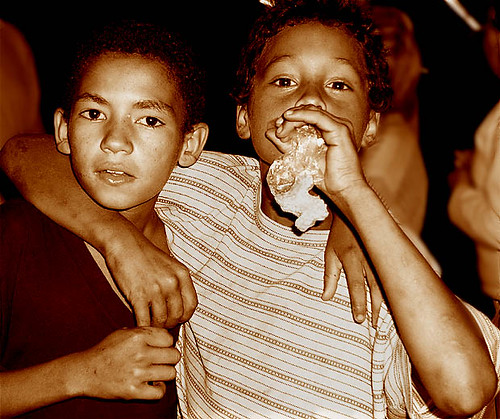
These photos of children at risk in the world are deply moving. I hope that your heart is broken as mine was when I viewed these.

All that I can think of are the words of William Booth: "We Will Reclaim Them!"

The Children At Risk Foundation – CARF was founded by Gregory J. Smith in 1992, determined to benefit the street children of Brazil by defending their rights and offering them a dignified and definitive solution so that they could live and grow within a family-oriented context and healthy social environment. Today, CARF attends approx. 600 children and young people each year through its preventive programmes at the Hummingbird Arts & Cultural Activity Centre (ECBF - Espaço Cultural Beija-Flor) in São Paulo. In 2007 CARF will be expanding its programmes by opening the first Hummingbird nucleus in one of the neighbouring favelas (shanties), making it possible to attend another 300 at-risk community children. The nucleus will be run by community youth who have been capacity trained through the Hummingbird project

Monday, September 03, 2007

More than 700 000 children are uninsured in America in 2006

Children's Defense Fund just reported this week that new census statistics show that more than 700 000 children have been uninsured in America in 2006.

Marian Wright Edelman of CDF states:

"It is a national disgrace that in just two years, the number of uninsured children has increased by a million in the richest nation on earth... This alarming jump demonstrates that our children need a strong national safety net so that every child has access to the health coverage needed to survive and thrive. It is shameful that despite overwhelming public support, the President appears to be doing everything in his power to prevent children from getting the critical health coverage they need. Congress has a moral obligation to stand up to the President and stand strong for children today to ensure a healthy America tomorrow."

Wednesday, August 29, 2007

Alice Cooper Opens Up Christian Youth Center (!)

This is one story that really blows my mind!

Alice Cooper, once known as the "Prince of Darkness," is now a committed Christian and planning to open a youth center in Phoenix for at-risk kids. He needs to raise $7.3 million to turn a piece of property at Grand Canyon University into a center that gives kids an opportunity to explore the world of music. The 29,000 square-foot center will have a recording studio, sound room, concert hall and a coffee house with a performance stage. All activities at the center will be underscored by a Christian message.

Monday, August 20, 2007

A City Without Fathers: The Blight of Newark, NJ Shows What Happens When Men Abandon their Children

Check out this horrifying news report. This is Newark, New Jersey, where Railton School students engage in ministry with The Salvation Army's Newark Urban Ministries.

A City Without Fathers: The Blight of Newark, NJ Shows What Happens When Men Abandon their Children

Steven Malanga
City Journal
Saturday, August 11, 2007

The horrific, execution-style killing of three teens in Newark last weekend has sparked widespread outrage and promises of reform from politicians, religious leaders and community activists, who are pledging a renewed campaign against the violence that plagues New Jersey's largest city. But much of the reaction, though well-intentioned, misses the point. Behind Newark's persistent violence and deep social dysfunction is a profound cultural shift that has left many of the city's children growing up outside the two-parent family -- and in particular, growing up without fathers. Decades of research tell us that such children are far likelier to fail in school and to fall into violence than those raised in two-parent families. In Newark, we are seeing what happens to a community when the traditional family comes close to disappearing.
According to 2005 figures from the U.S. Census Bureau, only 32% of Newark children are being raised by their parents in a two-adult household. The rest are distributed among families led by grandparents, foster parents and single parents -- mostly mothers. An astonishing 60% of the city's children are growing up without fathers. It isn't that traditional families are breaking up; they aren't even getting started. The city has one of the highest out-of-wedlock birthrates in the country, with about 65% of its children born to unmarried women. And 70% of those births are to women who are already poor, meaning that their kids are born directly into poverty.

The economic consequences of these numbers are unsettling, since single parenthood is a road to lasting poverty. In Newark, single parents head 83% of all families living below the poverty line. If you are a child born into a single-parent family in Newark, your chances of winding up in poverty are better than one in five, but if you are born into a two-parent family, those chances drop to just one in 12.

And the social consequences are even more disturbing. Research conducted in the 1990s found that a child born out of wedlock was three times more likely to drop out of school than the average child, and far more likely to wind up on welfare as an adult. Studies have also found that about 70% of the long-term prisoners in American jails, those who have committed the most violent crimes, grew up without fathers.

The starkness of these statistics makes it astonishing that politicians and policy makers ignore the subject of single parenthood, as if it were outside the realm of civic discourse. And religious leaders, who once preached against such behaviour, now also largely avoid the issue, even as they call for prayer vigils and organize stop-the-violence campaigns.

Often, in this void, the only information that our teens and young adults get on the subject of marriage, children and family life comes through media reports about the lifestyles of our celebrity entertainers and athletes, who have increasingly shunned matrimony and traditional families. Once, such news might have been considered scandalous; today, it is reported matter-of-factly, as if these pop icons' lives were the norm.

Faced with such a profound shift in attitudes, even well-designed, well-intentioned government programs that have worked elsewhere may have only limited success in a community like Newark. The city's dynamic new mayor, Cory Booker, has moved quickly to import successful ideas and programs, including rigorous quality-of-life policing from New York City. Booker is advocating sensible changes to fix the city's troubled school system, which graduates a shockingly low number of students, and he's looking at job training programs to get fathers involved, at least economically, in their children's lives.

But Booker has also shown frustration at the slow pace of change in Newark, and earlier this week he observed that the city's problems didn't start yesterday and won't be solved tomorrow. Given that some 3,750 kids are born every year into fatherless Newark families, Booker's prediction may be depressingly correct. - Steven Malanga is senior editor of City Journal and a senior fellow at the Manhattan Institute.

Tuesday, July 31, 2007

Growing Up in Poverty - 20/20 Documentary

Here is a YouTube link to a very moving documentary that came out earlier this year on 20/20 called, Waiting on the World to Change: The Hopes, Dreams and Hardships of Children in America's Most Dangerous City. This piece moved me so much - it reminded me of why I have dedicated my life to reclaiming children and youth through the ministries of The Salvation Army.

"While little children go hungry as they do now... I'll Fight!" William Booth

Tuesday, July 10, 2007

Bibliography from HOPE for Children in Poverty

I'm compiling a list of books referenced in HOPE for Children in Poverty. This is one of the most amazing lists of resources I have come across in recent days:

Bakke, O.M.; & McNeil, B. (2005). When children became people: The birth of childhood in early christianity. Augsburg Fortress Press.

Berstein, J.; Brocht, C.; & Spade-Aguilar, M. (2000). How much is enough? Basic family budgets for working families. Washington, DC: Economic Policy Institute.

Boxil, N. (1990) Homeless children: The watchers and the waiters. Binghampton: NY: Haworth Press.

Brendtro, L.K.; Brokenleg, M.; & Van Bockern, S. (2002) Reclaiming youth at risk: Our hope for the future, rev. ed. Bloomington, Il: Solution Tree.

Brooks-Gunn, J.B. & Duncan, G.J. (summer/fall, 1997). "The effects of poverty on children," The future of children, children and poverty 7, no.2.

Bunge, M.J. (2001). The child in christian thought. Grand Rapids: Eerdmans.

Children's Defense Fund. (August, 2005) "Defining poverty and why it matters for children." http://www.childrensdefense.org/site/DocServer/definingpoverty.pdf?docID=390. (Downloaded: July, 2007).

Children's Defense Fund. (1994) Wasting America's future. Boston: Beacon.

Children's Sentinel Nutrition Assessment Program (C SNAP). (2004) The safety net in action: Protecting the health and nutrition of young American children. Boston: C SNAP. (p.1)

Claiman, V.; Butler, D.; & Boyatt, J. (1994) Acting on your faith: Congregations making a difference, A guide to success in service and social action. Boston: Insights.

Couture, P. (2000) Seeing children, seeing God: A practical theology of children and poverty. Nashville, TN: Abingdon.

Crawford, P.M. et al. (January-March 2004). "How can Californians be overweight and hungry?" California Agriculture 58: 1.

Dahl, G. & Lochner, L. (August, 2005). "The impact of family income on child achievement," Institute for Research on Poverty, Discussion Paper 1305-05.

Daley, S. & Guy, K. (1994) Welcome the child: A child advocacy guide for churches. New York: Friendship Press and Children's Defense Fund.

DeNavas-Walt, C.; Proctor, B.; & Lee, C.H. (2006). Current population reports, P60-231. "Income, Poverty, and Health Insurance Coverage in the United States: 2005" U.S. Census Bureau. (p.52)

Department of Health and Human Services. (2007). Suicide: Fact sheet. Centers for Disease Control and Prevention.

Dodson, L. (1999) Don't call us out of name: The untold lives of women and girls in poor America. Boston: Beacon Press.

Edelman, M.W. (1995) Guide my feet: Prayers and meditations on loving and working for children. Boston: Beacon Hill. (p.183f.)

Ehlig, B. & Payne, R. (1999) What every which member should know about poverty. Aha! Process.

Elliott, B. (2004). Street saints: Renewing America's cities. Radnor, PA: Templeton Foundation Press.

Fass, S. & Cauthen, N.K. (September, 2005). "Child poverty in states hit by Katrina," New York: National Center for Children in Poverty, Fact Sheet No 1.

Forum on Child and Family Statistics. (2006). "America's children in brief: Key national indicators of well-being, 2006."

Forum on Child and Family Statistics. (2005). "America's children: Key national indicators of well-being, 2005."

Frank, D.A. (July 16, 2003). Statement before the subcommittee on education reform -Committee on education and the workforce. U.S. House of Representatives.

Huston, A.C. (1991) Children in poverty: Child development and public policy. New York: Cambridge University Press.

Johnson, J. (2001) Growing compassionate kids: Helping kids see beyond their backyard. Nashville: Upper Room.

Keller, T. (1989) Ministries of mercy: The call of the jericho road. Phillipsburg, NJ: P&R.

KidsCount. (2006). 2006 Kids count data book: State profiles of child well-being. The Annie E. Casey Foundation.

Kozol, J. (1996) Amazing grace: The lives of children and the conscience of a nation, 2nd ed. New York: Harper Perenniel.

Larson, D.B.; & Johnson, B.R. (1998) Religion: The forgotten factor in cutting youth crime and saving at-risk urban youth. Jeremiah Project Report 98-2. New York: The Manhattan Insititute.

Ludwig, J. & Mayer, S. (Fall, 2006) "Culture and the intergenerational transmission of poverty: The prevention paradox." The Future of Children 16, 2: 175.

Lupton, R. (2007) Compassion, justice, and the christian life: Rethinking ministry to the poor. Ventura, CA: Regal Books.

Mayer, S.E. (1997) What money can't buy: Family income and children's life chances. Cambridge, MA: Harvard University Press.

Miller, K & Wilson, M. (1985) The church that cares: Identifying and responding to needs in your community. Valley Forge, PA: Judson Press.

National Center for Children in Poverty (NCCP). (September, 2006) Basic facts about low-income children: Birth to age 18. New York: Columbia University: Mailman School of Public Health.

National Center for Children in Poverty (NCCP). (April, 2006) On the edge in the empire state: New York's low-income children. New York: Columbia University: Mailman School of Public Health.

National Coalition for the Homeless. (June, 2006). "Fact sheet #2: How many people experience homelessness."

Nord, M.; Andrews, M.; & Carlson, S. (2005). Household security in the United States, 2004. Washington, DC: United States Department of Agriculture.

Odom, R. (2006) Suffer the children: The impact of poverty on America's future. Minneapolis: Love INC. (p.4)

Perkins, J. (1995) Restoring at-risk communities: Doing it together and doing it right. Grand Rapids: Baker.

Rank, M.R. (2004). One nation, underprivileged: Why American poverty affects us all. New York: Oxford University Press.

Regnerus, M.D. (2002) "Making the grade: The influence of religion upon the academic performance of youth in disadvantaged communities," CRRUCS Report. Philadelphia, PA: Center for Research on Religion and Urban Civil Society.

Richardson, W. (1996) Reclaiming the urban family: How to mobilize the church as a family center. Grand Rapids: Zondervan.

Roehlkepartain, J.L. (2000) Teaching kids to care and share. Nashville: Abingdon.

Rusaw, R. & Swanson, E. (2004) The externally focused church. Loveland, CO: Group.

Sampson, R.; Raudenbush, S.; & Earls, F. (August, 1997) "Neighborhoods and violent crime: A multilevel study of collective efficacy," Science 277.

Sanfers, C. (1997) Ministry at the margins. Downers Grove, IL: InterVarsity Press.

Schein, V.E. (1995) Working for the margins: Voices of mothers in poverty. Ithaca, NY: Cornell University Press.

Schwarz, J.E. & Volgy, T.J. (2004). Forgotten Americans: Thirty million working poor in the land of opportunity. New York: Norton.

Sherman, A.L. (2001) The abcs of community ministry: A curriculum for congregations. Washington, DC: Hudson Institute.

Shipler, D.K. (2004). The working poor: Invisible in America. New York: Knopf.

Sider, R.J. (2007) Just generosity: A new vision for overcoming poverty in America , 2nd ed. Grand Rapids: Baker.

Sider, R.J.; Oldon, P.; & Unruh, H.R. (2002) Churches that make a difference: Reaching your community with good news and good works. Grand Rapids: Baker.

Stanton, G. (?) Suffer the little children. Youthworks College.

Strange. W.A. (1996). Children in the early church. Eugene, OR: Wipf and Stock.

Toppo, G. (June 20, 2006). "Big-City Schools Struggle with Graduation Rates," USA Today.

U.S. Department of Education, National Center for Education Statistics (NCES). (2001). Public elementary/seconday school universe survey, 1999-2000.

U.S. Department of Health and Human Services. (September, 1996). National Center on Child Abuse and Neglect, Third national incidence study of child abuse and neglect, NIS 3 (Executive Summary).

U.S. Department of Health and Human Services, Administration on Children, Youth and Families. (2006) Child maltreatment 2004.

U.S. Department of Justice, Office of Juvenile Justice and Delinquency Prevention. Browing, K.; Thornberry, T.; & Porter, P. (April, 1999) "Highlights of findings from the Rochester youth development study," OJJDP Fact Sheet #103, FS 99103.

Van Groningen, J. (2005) Communities first. Grand Rapids: CRWRC.

Weber, B. et al. (October, 2005). "A critical review of rural poverty literature: Is there truly a rural effect?" Institute for Research on Poverty, Discussion Paper 1309-05.

Wood, D. (September, 2003). "Effect of child and family poverty on child health in the United States," Pediatrics 112, no.3, 707.

Wood, D. (1994). The church and childhood: Studies in church history. Ecclessiastical History Society.
HOPE for Children in Poverty: Profiles and Possibilities

This is the book I have been waiting for somebody to publish for years...

HOPE for Children in Poverty: Profiles and Possibilities is one of the most essential tools that I would recommend as a must read for anyone involved in youth work in the United States. Edited by Ron Sider and Heidi Unruh, they take us deep into the world of children and youth who are suffering the ravaging abuse of poverty.

The first section deals with the lives of children in poverty. They are not merely presenting quantitative evidence of poverty, but are also amplifying the voices of these children that qualitatively support why poverty is an issue that desperately needs to be addressed in this nation.

The second section explores the special concerns of children in poverty - addressing the difficulties of family life, and need for reform in education-, health care-, and welfare-systems. However, this book is not simply a rant complaining about the problems - it also looks at the possibilities that exist - profiling (in particular) faith-based initiatives that are responding to the cries of today's youth.

In the third section, they explore Biblical reflection on children in poverty. As an evangelical, I appreciate their reminder that our commitment to reclaim children and youth is rooted at the core of our faith tradition. This is not something to be a sidebar of our faith - it is at the core of what it means to be a disciple of Jesus.

The Appendices are worth their weight in gold - loading the reader with a ton of recommended resources that help us understand child poverty and mobilize the church to respond to poverty. I was especially encouraged when they quote Railton School's theme verse: Isaiah 1:17 - stating, "God is inviting you to 'learn to do good.' ...Just as the needs are great, the possibilities for ministry are endless. No one can do everything... but we are all called to do something" (p.164). I challenge you to READ THIS BOOK - it is a manifesto truly on reclaiming children and youth.

As I read these articles from youth work giants like Marian Wright Edelman, Jonathon Kozol, and Amy Sherman; I find myself encouraged, challenged, and fueled to continue to do my utmost to be like Jesus. I pray that you, too will experience the fire in the belly I felt after reading this.

Click here to access the study guide that Judson Press has put out to accompany this book.

Wednesday, May 16, 2007

Youth At-Risk for Truancy Detour Into Faith-Based Education Program: Their Perceptions of the Program and Its Impact

Youth At-Risk for Truancy Detour Into Faith-Based Education Program: Their Perceptions of the Program and Its Impact

Jill Witmer Sinha
University of Pennsilvania

Many minority adolescents in the United States today are at a high risk for truancy, dropout, and academic under-achievement. Truancy is related to a host of preceding and subsequent risks such as delinquency and limited vocational outcomes. Using participatory research methods, this federally funded, 10-month study assessed youths' perceptions of a publicly funded, faith-based, alternative education program with 73 minority youth participants who were at risk for truancy. The study assessed whether change occurred in peer dynamics, youths' use of time, and educational aspirations. The program was found to have a positive impact on peer dynamics and the use of both school hours and free time. The program supported or did not hamper educational aspiration. Implications about the impact of alternative education programs for at-risk youth and the faith-based nature of the program are discussed.

Friday, May 11, 2007

Frontline: Juvenile Justice

Should teenagers who commit serious crimes be tried as juveniles or adults? What happens to young offenders who reach the 'end of the line' in the juvenile court system - and how do you rehabilitate these young people to prevent future criminal behavior? FRONTLINE explores these questions as it follows four juvenile offenders - one white, two Hispanic, and one African American - through the Santa Clara, California, juvenile courts, observing how the criminal justice system treats their cases and determines their fates.

OFF BALANCE: Youth, Race & Crime in the News

Frontline: When Kids Get Life

"The U.S. is one of the few countries in the world that allows children under 18 to be prosecuted as adults and sentanced to life without parole. Currently there are more than 2000 of these young offenders imprisoned for the rest of their natural lives. This is the story of five of them in the state of California."

At Project 1:17, this semester we have been looking at the Juvenile Justice system. I believe that as William Booth said that we should "go for souls and go for the worst" - our commitment to work with youth whom society has deemed, "the worst of the worst" should be the people who we care for and minister to. This Frontline Documentary, When Kids Get Life, captures this world. You can watch the show online and explore the webpage for a variety of additional resources.

I have become more and more fascinated with correctional ministry - I would love to see more and more Salvationists get involved in chaplaincy in these types of facilities.

Thursday, May 03, 2007

Making a Difference in the Lives of Youth: An Urgent Agenda

This is a presentation from the White House's Helping America's Youth program. This presentation, called Making a Difference in the Lives of Youth: An Urgent Agenda is by Larke Huang. It was presented on April 11, 2007 at the Regional Conference.

Preventing Drug Use Among Children and Adolescents

Preventing Drug Use Among Children and Adolescents presents the updated prevention principles, an overview of program planning, and critical first steps for those learning about prevention. Thus, this shortened edition can serve as an introduction to research-based prevention for those new to the field of drug abuse prevention. Selected resources and references are also provided.

Friday, December 01, 2006

The State of America's Children

Marian Wright Edelman has founded the Children's Defense Fund that advocates for children who are at-risk in America. This is their report on The State of America's Children the year 2005. It is a great resource for understanding what the critical needs are for youth in America.

Tuesday, June 20, 2006

Emmy Werner - Studying Resilient Children and Youth

Emmy E. Werner and Ruth S. Smith have written a critical piece of literature in the study of resiliency and high risk youth called Vulnerable but Invincible: A Longitudinal Study of Resilient Children and Youth.

Here's a sample quote on the importance of a community working together to help parent a child - an alternative to a more individulatistic model:

When asked what helped them succeed against the odds, resilient children, youth, and adults overwhelmingly and exclusively gave the credit to members of their extended family, to neighbors and teachers, to mentors and voluntary associations and church groups.